Table of Contents
- Introduction
- The Urgent Mandate: Stop Building Websites That Expose Your Practice
- The Solo Practitioner's Website TCO: Platform vs. Agency Audit
- The 2026 AI-Ready Architecture for Medical Website Development
- The Patient Acquisition Engine: Dominating Local Search in 2026
- Conclusion: The Single, Predictable Solution for Your Medical Website Development
- FAQs on AI-Ready Medical Website Development for Solo Practices
AI-Ready Medical Website Development for Solo Practices
.jpg?width=700&height=350&name=Copy%20of%20Blue%20Pink%20Modern%20Special%20Offer%20Sale%20Banner%20(9).jpg)
Key Takeaways From The Blog
- The 2026 Mandate: Your website is no longer just a digital brochure; it is a regulated clinical asset.
- The Solo Practice Risk: A generic agency or DIY site exposes you to a $50,000 HIPAA fine because it lacks BAA coverage for key features.
- The Blueprint: True AI-ready Medical Website Development requires a single-platform solution (like PracticeBeat) that combines guaranteed compliance with patient-acquisition automation.
- The Conversion Goal: Websites must be optimized for patient booking ROI, not just aesthetics.
As healthcare moves into 2026, the role of a medical website is undergoing a fundamental shift.
For solo physicians and independent practices, a website is no longer just a static online presence. It is becoming a regulated, high-stakes digital system—one that must balance patient acquisition, data security, automation, and HIPAA compliance simultaneously. And yet, most sites in use today were built for aesthetics rather than for audits.
The traditional Medical Website Development model is fundamentally broken for the solo practitioner. It is often non-compliant, costly, and fails to deliver the patient-acquisition ROI that physicians are promised.
Built from fragmented, third-party tools, the typical approach to healthcare website design quietly transfers massive compliance risk back to the physician—without transparency, accountability, or protection.
With AI-powered chat, secure online scheduling, and digital patient communication tools quickly becoming standard, the margin for error is shrinking fast.
This is why PracticeBeat was built for this reality.
PracticeBeat is an all-in-one digital growth platform specifically designed for solo and independent medical practices.
This blueprint outlines how to prepare for 2026 with confidence—by choosing a website that is HIPAA-compliant by design, future-ready for AI, and engineered to consistently convert visitors into patients, all while guaranteeing compliance under a single BAA.
This is no longer optional. Compliance is the only viable path to successful medical practice website design today.
The Road Ahead: Turning Your Website into a Compliance-First Patient Magnet
Now that the stakes are clear, it’s time to explore how this strategic medical website development blueprint will give solo practices a step-by-step roadmap to thrive in the new era of healthcare digital presence.
The Urgent Mandate: Stop Building Websites That Expose Your Practice

For the modern solo practitioner, a website is no longer just a digital business card—it is a functional extension of the clinic. However, if your site is built on standard consumer platforms like Wix, Squarespace, or WordPress, you aren't just building a practice; youare creating a liability.
Following aggressive sixth enforcement actions in 2025, the Office for Civil Rights (OCR) has fully shifted to a "zero-tolerance" enforcement model, aggressively penalizing foundational HIPAA failures regardless of a provider's size. Thus, making MFA and full data encryption non-negotiable requirements for all solo providers and independent practices.
Moreover, under the OCR enforcement actions, a single late response to a patient record request can now trigger a formal settlement and fine. With fines reaching $1.5M per category, non-compliance is an existential threat to private practice viability.
In 2016, the Feinstein Institute for Medical Research (Northwell Health) paid $3.9 million to settle HIPAA violations after a stolen laptop exposed the data of 13,000 patients.
While that case involved a large research system and physical theft, the OCR’s 2025 "Risk Analysis Initiative" applies the same logic to the digital presence of solo practices.
For a small practice, a non-compliant website is an unshielded gateway that exposes patient data to the open web, often resulting in "willful neglect" penalties because the tools to secure them are now considered basic industry standards.
Under recent HIPAA Security Rule updates implemented throughout 2025, the distinction between "addressable" and "required" specifications has been effectively eliminated.
The following chart outlines the 2025 penalty tiers, illustrating how even 'unintentional' lapses now carry significant financial consequences for private practices:
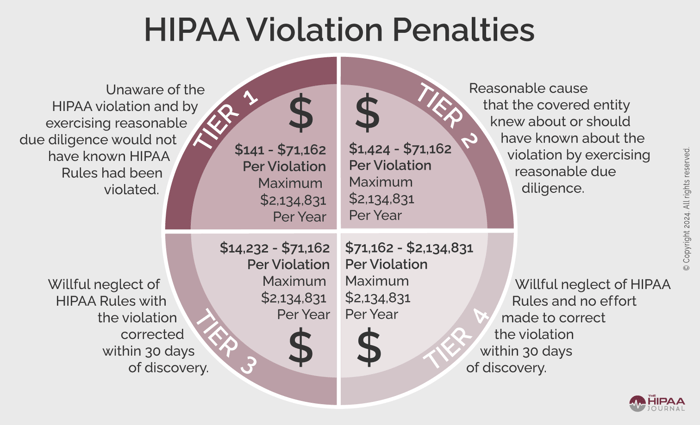
HIPAA Violation Tiers and Penalties (Source: HHS.gov)
As these penalty tiers demonstrate, the era of "flexible" compliance has ended. Every technical safeguard is now mandatory, regardless of your practice size. This fundamentally changes the requirements for successful medical website development heading into the new year, moving security from a "best practice" to a legal necessity for survival.
The 2026 Survival Checklist: Your Mandatory Safeguards
To protect your license and your livelihood in the new year, your digital presence must adhere to these non-negotiables:
- End-to-End Encryption: All patient data at rest and in transit must be encrypted using AES-256.
- Mandatory MFA: Multi-factor authentication is now required for any system that touches patient data, including your website’s backend.
- Verified BAAs: You must have a signed BAA from your host, your email provider, and your form builder.
- 72-Hour Reporting: If a breach is discovered, the window to notify the HHS has been slashed from 60 days to just 72 hours for breaches affecting more than 500 people.
The 2026 Solo Practice Website is a Liability, Not an Asset
- The Compliance Time Bomb: Most generic developer forms and contact systems are not HIPAA-compliant, making the solo practitioner personally liable for fines up to $50,000 for unauthorized PHI disclosure.
- The Cost Sinkhole: Traditional development agencies charge $10,000+ upfront for a medical website design, then another $200-$500/month for "maintenance" that doesn't guarantee compliance or effective patient acquisition.
- The AI Obsolescence: Websites not built to integrate safely with 2026's AI tools are already falling behind competitors, leading to patient leakage and wasted marketing spend. This is the new reality for medical practice website design.
ACTION REQUIRED: Is Your Website Hiding a HIPAA Exposure?
The Solo Practice Compliance Audit: Find Your Gaps in 10 Minutes.
For solo practitioners, facing fines of up to $350,000 for unsecured forms, missing BAAs, and hidden marketing pixels is an existential threat that standard Medical Website Development fails to address.
Stop operating blind. Practicebeat is offering a limited, zero-risk MarketShift Risk Diagnosis based on industry-standard compliance models.
This 10-minute session will:
- AUDIT: Review your existing URL to identify the most common HIPAA gaps that expose solo practices to OCR enforcement.
- CLARIFY: Detail the Potential Financial Exposure your practice faces due to non-compliant features.
- SOLVE: Demonstrate precisely how the Practicebeat platform provides a proven solution that provides compliance and closes these gaps immediately.
Protect your license before your competitor secures the solution.
To ensure full onboarding compliance, we are strictly limiting new solo practice MarketShift Demos to 15 this month. Protect your license before your competitor secures the solution.
YES, START MY RISK DIAGNOSIS & Secure My Demo Slot!
The Solo Practitioner's Website TCO: DIY vs. Agency Audit

The initial acquisition cost of a medical website development project is a marketing fiction. The true measure of any solution is its Total Cost of Ownership (TCO) over a three-year lifecycle, factoring in hidden fees, maintenance, and non-compliance legal exposure. This TCO audit proves that choosing the wrong development model is the single biggest financial mistake a solo practitioner can make.
In healthcare marketing, the Total Cost of Ownership (TCO) for a solo practitioner's website in the USA is defined by the high cost of HIPAA compliance. Failing to implement technical safeguards, such as encryption, or failing to enter into a Business Associate Agreement (BAA) can trigger "Willful Neglect" fines starting at $71,162 per violation. (Table above)
The Three-Year Financial Reality (Platform vs. Agency vs. Practicebeat)
.jpg?width=700&height=350&name=Copy%20of%20Blue%20Pink%20Modern%20Special%20Offer%20Sale%20Banner%20(10).jpg)
Platform Audit (The DIY Route): The Illusion of Low Cost
The DIY route (using platforms like WordPress or Wix) offers the lowest 3-year TCO ceiling, but the numbers are deceptively low because they don't account for your time or liability.
- Hidden Costs of "Cheap" Hosting: Many standard providers do not offer a BAA on entry-level plans. To get one, you often need to upgrade to an Enterprise tier or use specialized HIPAA hosts like HIPAA Vault or Atlantic.Net, which start at $50–$200/mo. This immediately adds significant, often unexpected, cost.
- Security Debt: Solo practitioners are personally responsible for implementing and documenting technical safeguards. In 2026, the OCR increased its focus on online tracking pixels (e.g., Google/Meta) on appointment pages, which are considered unauthorized PHI disclosures if not correctly configured. This DIY compliance headache is why platforms are now essential for solo GPs to automate policy generation and risk alerts without hiring a consultant.
Agency Audit (The Managed Route): The Cost Sinkhole
The specialized agency route guarantees compliance, but at a punishing financial cost that crushes the margins of a solo practice.
- Risk Transfer: The primary value of an agency is the assumption of technical liability and handling the annual Risk Analysis (mandatory under the Security Rule). They ensure all vendors (email, forms, CRM) have signed BAAs.
- Opportunity Cost (The Time Tax): While the agency route costs 2-4x more upfront, it saves an estimated 150–200 hours of administrative work over 3 years. For a practitioner billing $200/hr, this represents **$30,000–$40,000** in recaptured billable time. The agency locks the doctor into high monthly fees to protect this time.
- The Vendor Lock-In Trap: Even with an agency, you often have 3-5 separate vendors, leaving your compliance fragmented. A few all-in-one platforms offer a middle ground by providing a compliant website builder and EHR for one fee. However, they offer less SEO and marketing customization than a dedicated medical website development partner.
Pro Tip: For a deeper dive into why professional agency beats trial-and-error website development and healthcare marketing for private practices, read our comparison on Healthcare SEO Agency vs. DIY Marketing."
The Practicebeat Advantage
Practicebeat transforms compliance from a liability into a platform utility.
Instead of juggling separate line items for security, hosting, and BAAs, we bundle your entire digital infrastructure into a single, predictable subscription. Our 'Compliance-First' architecture and 'Patient-First' medical website development services don't just lower your TCO, it eliminates the 'security debt' that keeps solo practitioners awake at night.
Before you read another word: The NEXT LOGICAL STEP is to see the exact price for your specific solo practice needs and claim your high-value audit.
You now know the truth: Whether you pay $18,000 to an agency or risk a $71,162 fine on a DIY platform, the traditional Medical Website Development models are designed to fail the solo practitioner. The high cost of compliance prevents small practices from achieving the patient-acquisition ROI they need.
STOP HIDING! The only way to win the rank war and stop the legal liability is through a Compliance-First Architecture.
The Practicebeat Advantage starts with a Zero-Risk, $2,500 Value Risk Diagnosis, which we are giving away for free and guaranteed to increase your Inbound Potential immediately.
Claim Your Customized & FREE $2,500-Value Audit Now!
The 2026 AI-Ready Architecture for Medical Website Development

The new mandate for medical website development is not just compliance; it's integration. A solo practice website must act as the smart nerve center for the entire clinic, securely connecting the public interface to the private patient management systems. Failure to build on an AI-ready architecture guarantees obsolescence within 18 months, turning your healthcare website design into a relic.
In 2026, medical website development for solo practitioners has shifted from static "digital brochures" to active, AI-native portals. As regulatory bodies like the ONC and HHS tighten oversight, these features are no longer luxuries but requirements for maintaining compliance and profitability.
The Three Pillars of Compliant, AI-Native Patient Acquisition
The Practicebeat platform is built to solve the solo practitioner's core problem: leveraging AI to cut costs without risking HIPAA fines.
1. Agentic Patient Navigation
Traditional chatbots are being replaced by Agentic AI, which performs multi-step, intelligent actions rather than just providing scripted answers. This functionality is essential for modern medical practice website design.
- The Feature: An autonomous assistant that handles intelligent triage—gathering symptoms, assessing urgency based on clinical protocols (like Schmitt-Thompson), and routing the patient to the correct care level.
- The Compliance Hurdle: Generic third-party chatbots are a primary HIPAA liability because they store conversational data on servers that lack BAAs. The OCR is aggressively targeting this.
- Why It's Non-Negotiable: In 2026, state laws (like those in Texas and California) require "nutrition-label"-like disclosures and plain-language transparency when AI is used in high-risk health communication. The Practicebeat platform ensures this transparency is built in, protecting the solo provider.
2. Predictive Demand-Based Scheduling
AI-driven scheduling has moved beyond simple calendar integration to predictive analytics that optimize the practice's bottom line. For any medical website development project, ROI is now measured in no-show reduction.
- The Feature: Systems like Predictive Scheduler analyze historical patient patterns to forecast no-shows and automatically prioritize high-need patient slots. It integrates with your EHR via a secure tokenized API.
- The Cost Savings: No-shows cost the US healthcare industry over $150 billion annually. Predictive tools can reliably recapture $400–$600 per day in revenue by keeping the schedule dense yet flexible. This feature alone justifies the platform investment.
- MFA Mandate: The entire scheduling interface is governed by the 2026 HIPAA update requiring Mandatory Multi-Factor Authentication (MFA) for all staff access, a non-negotiable feature in the Practicebeat framework.
3. Interoperable "Ambient" Document Intake
The website is now the primary entry point for Ambient Clinical Intelligence (ACI), which bridges the gap between patient intake and the EHR. This ensures seamless data flow, a core requirement of modern healthcare website design.
- The Feature: Secure, FHIR-compliant APIs that allow patients to upload or dictate their health history via the website, which is then automatically summarized and structured into the patient record using Natural Language Processing (NLP).
- The Regulatory Imperative: New ONC HTI-2 mandates require certified systems to demonstrate seamless data exchange using FHIR R4 APIs. Systems that lack this interoperability risk being excluded from major provider networks and reimbursement cycles.
- Zero Trust Baseline: Every AI feature is backed by a signed Business Associate Agreement (BAA) and utilizes Zero Trust security models, including multi-layered authentication and AI-driven anomaly detection to prevent unauthorized data access.
Too technical? That’s why we’re here.
You don’t need to be an IT expert to have an elite practice. Book a strategy session with PracticeBeat experts, and we’ll translate these technical requirements into a seamless, automated workflow for your office.
The Final Mandate: Your Website Must Be an Investment in Time, Not a Tax on Compliance
The choice facing the solo practitioner is clear. You can continue investing in fragmented systems with high maintenance costs, multiple BAAs, and inherent legal risk, or you can invest in a predictable, AI-ready architecture that makes compliance its primary feature.
Don't Wait for a $50,000 HIPAA Fine.
Schedule a FREE DEMO with PracticeBeat experts. We will immediately scan your site for the most common HIPAA vulnerabilities and show you the precise fix in a zero-risk audit.
BOOK YOUR FREE HIPAA AUDIT NOW
The Patient Acquisition Engine: Dominating in 2026 with AI-Driven Authority

It doesn't matter how compliant or AI-ready your medical website development is if no patients can find it. For a solo practice, your website’s core mission must be to dominate your local service area. This requires a specific patient acquisition engine strategy that goes far beyond general healthcare website design.
The New Mandate for 2026
1. Generative Engine Optimization (GEO): The Next-Generation SEO
In 2026, patients are rapidly shifting to AI assistants (e.g., Google Gemini, Microsoft Copilot) to find local care rather than manually searching for symptoms. Traditional SEO is being rapidly replaced by Generative Engine Optimization (GEO), the strategy required by these new AI tools.
- How it Works: AI assistants will summarize website content into direct, conversational answers. To rank, a site must provide high-quality, easily verifiable medical information that AI models can ingest and summarize without ambiguity. This is critical for any serious medical website development project aiming for future relevance.
- The Blueprint: Content structure must pivot from general articles to direct answers to common patient questions (e.g., "What are the first signs of plantar fasciitis?"). This ensures your solo practice is cited as a primary, authoritative source when an AI assistant recommends a provider in your area. Practicebeat’s built-in GEO content tools automate this process.
2. Schema Markup 3.0: The AI Roadmap for Credentials
To be visible to 2026's AI crawlers, a website must use advanced medical schema (Schema 3.0) to provide structured data that AI models prioritize. Without this structured data, your solo practice is invisible to the most advanced search technology.
- Non-Negotiable Tags: The code must explicitly define the NPI number, accepted insurance plans (using specific payer codes), and specific medical procedures offered (using SNOMED or ICD codes). This level of detail confirms the AI's expertise and eligibility.
- The Benefit: This structured "roadmap" allows AI engines to instantly verify credentials, confirm the legitimacy of your medical practice website design, and match the practice with patients searching for specific insurance or specialty needs. This precision targeting converts search visibility directly into booked appointments.
3. Verified Authority: BAA-Compliant Reviews and E-E-A-T
AI models in 2026 will prioritize "high-trust" sources, making a compliant reputation management system a core part of SEO and E-E-A-T in medical practice website design.
- Compliant Systems: The only sustainable way to build this trust is to use platforms that sign a Business Associate Agreement (BAA). This is a critical point: without a BAA, collecting reviews that mention specific treatments or conditions is a major HIPAA violation (under PHI).
- AI Integration: Practicebeat’s HIPAA-compliant review systems securely feed verified patient testimonials into the "knowledge graphs" used by AI search engines. This builds the "Verified Authority" status AI assistants require for top rankings without exposing your solo practice to legal risk.
4. The Agentic Triage & Zero Trust Security Acquisition Loop
The 2026 website must be an active, trustworthy participant in patient care through Agentic AI and hardened security.
- Agentic Triage: The ultimate conversion tool is replacing standard, high-friction forms with an Agentic AI assistant that performs preliminary clinical triage and directs patients to the proper care pathway. This is essential for local acquisition, as patients demand an immediate, intelligent response.
- Zero Trust Architecture: This level of advanced interaction requires non-negotiable security. Under the latest HIPAA Security Rule updates, all sites must use Multi-Factor Authentication (MFA) and AES-256 encryption at rest and in transit. This Zero Trust Architecture is fundamental to the Practicebeat platform, ensuring your patient acquisition engine operates securely and legally.
Is Your Medical Practice Ready for 2026? Secure Your 2026 Market Shift
Stop risking your practice's future on generic development that fails to book patients or secure your data. Your competitors are already reading this blueprint and acting on it.
CLAIM YOUR FREE 2026 AI Roadmap Consultation.
See the exact features that will drive your patient flow and get a Customized Compliance Report for your practice.
Shift Your Practice! Start Practicebeat 2026 MarketShifter Demo.
PracticeBeat Medical Website Development: Be 2026-Ready
The era of fragmented medical website development is over. The audits in this blueprint prove that the traditional agency model is a costly sinkhole, and the DIY platform route is a catastrophic legal gamble. Any willful neglect can cost hefty fines.
For any solo practitioner, the success of healthcare website design depends on integration.
The Practicebeat AI-Ready Blueprint is the difference between a website that works for you and one that works against you. Take control of your compliance and patient flow today.
Practicebeat guarantees the lowest compliant TCO by eliminating the four hidden costs of fragmentation and redefining medical website development:
- Cost Elimination: We replace multiple vendor fees and BAAs with a Single BAA and a zero-trust architecture that is inherently compliant with 2026 HIPAA Security Rules and ONC mandates.
- Time Recapture: Our Online Scheduling can automate up to 40% of your administrative workflow, turning your solo practice website into a reliable digital assistant.
- Rank Dominance: We utilize Generative Engine Optimization (GEO) and Schema to ensure your medical website development investment dominates local search and guarantees patient acquisition.
The choice is now simple: Continue paying the compliance tax to multiple, non-integrated vendors, or make a single, predictable investment in the only platform built from the ground up to secure and grow your solo practice with compliant medical website development.
Stop Guessing: Claim Your Zero Trust Compliance Guarantee.
Your practice's liability ends in 10 minutes. Book a FREE Assessment and get the only compliant healthcare website design blueprint.
Verify My Zero Trust Status - A secure foundation upon which your AI-driven patient acquisition engine will thrive.
Start building that foundation, and your competitive edge, right NOW.

FAQs on AI-Ready Medical Website Development for Solo Practices

Q1: Why is a single Business Associate Agreement (BAA) so critical for my Medical Website Development project?
A Single BAA drastically reduces legal exposure by placing all data handling—from hosting to forms to compliance tools—under one legally accountable entity (Practicebeat). Using DIY platforms for your healthcare website design often means juggling 3-5 separate vendors, each requiring its own BAA. A single missing BAA is a direct path to a major HIPAA violation, making compliant medical website development impossible without a unified platform.
Q2: What is Generative Engine Optimization (GEO), and how does it change my solo practice website SEO?
GEO is the strategy of optimizing content so it can be easily summarized and cited by modern AI assistants. This is the future of medical website development. GEO ensures your solo practice website uses specific, structured content (Schema Markup 3.0) and high-authority answers so that AI recommends your practice as the primary source, directly translating search visibility into appointments—a key measure of successful medical website development.
Q3: What is Agentic AI, and how does it benefit my solo practice website's patient acquisition?
Agentic AI goes beyond basic chatbots by autonomously performing complex, multi-step actions (e.g., patient triage, pre-screening, and intelligent scheduling) directly on your solo practice website. This is the key to AI-Ready Medical Website Development because it automates up to 40% of administrative tasks, turning website visitors into booked appointments without staff intervention, thus maximizing patient acquisition ROI.
Q4: How does Practicebeat guarantee HIPAA compliance where generic platforms fail?
Practicebeat ensures continuous HIPAA compliance by design. Our platform is built on a Zero Trust Architecture and provides a single, legally-backed Business Associate Agreement (BAA) covering all features—from hosting and forms to Agentic AI. This eliminates the compliance gaps common in fragmented DIY Medical Website Development and protects the solo practice website from the risk of Willful Neglect exposure.
Q5: How do the FHIR R4 API mandates affect my healthcare website design?
The FHIR R4 API compliance, mandated by the ONC, is non-negotiable for modern healthcare website design. It ensures that patient data collected on your website (intake, scheduling requests) can be securely and seamlessly exchanged with your Electronic Health Record (EHR). Any Medical Website Development lacking this interoperability creates administrative friction and fails to meet the 2026 data integrity standard.
Q6: Can Practicebeat's AI architecture help my solo practice website with appointment no-shows?
Yes. Practicebeat's AI-Ready Medical Website Development includes Predictive Demand-Based Scheduling. This feature leverages AI to analyze historical patterns, forecast no-shows, and automatically optimize the schedule or notify waitlisted patients. This automation can reliably recapture significant revenue by maximizing the efficiency and utilization of the solo practice website scheduling engine